
Lithuania’s rich history is marked by grand castles and imposing fortresses that once played a crucial role in defending the nation against invaders and shaping its cultural identity. As a land that stood at the crossroads of medieval Europe, Lithuania was frequently engaged in conflicts, particularly against the Teutonic Order and neighboring powers. This resulted in the construction of impressive fortifications that not only provided protection but also served as centers of governance, commerce, and noble residence. Today, these castles and fortresses stand as magnificent testaments to Lithuania’s resilience and architectural heritage, attracting history enthusiasts, travelers, and photographers alike. From the fairy-tale beauty of Trakai Island Castle to the medieval grandeur of Kaunas Castle and the historic ruins of Medininkai, Lithuania’s fortifications offer an unforgettable journey through time.

Trakai Island Castle: The Jewel of Lithuania
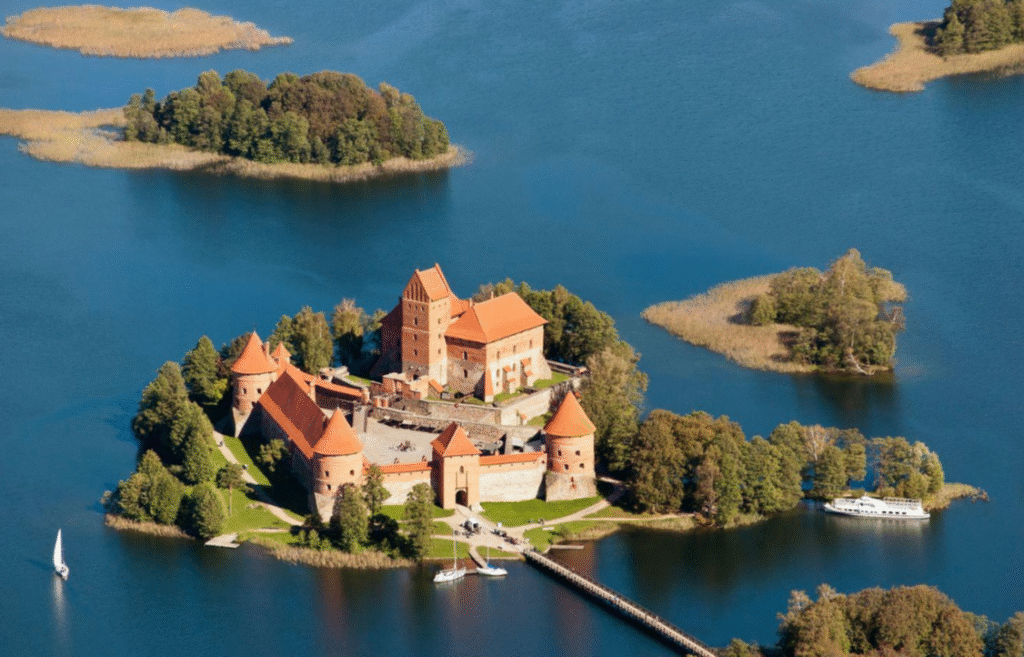
Trakai Island Castle is undoubtedly one of Lithuania’s most iconic and picturesque landmarks. Situated on an island in Lake Galvė, this red-brick fortress, surrounded by shimmering blue waters and lush forests, appears as if it was lifted straight from a medieval fairy tale. Built in the 14th century by Grand Duke Kęstutis and later expanded by his son, Vytautas the Great, Trakai played a significant role in the defense of the Grand Duchy of Lithuania.
The castle was strategically positioned to protect against attacks from the Teutonic Order, a major adversary of Lithuania during the Middle Ages. With its high towers, fortified walls, and wooden drawbridge, Trakai was an almost impregnable stronghold. Over the centuries, it evolved into a political and administrative center, where Lithuanian dukes hosted diplomatic meetings and royal celebrations.
Today, Trakai Island Castle is a major tourist attraction and a key cultural site. Visitors can explore its restored halls and chambers, which house an extensive museum showcasing medieval artifacts, armor, and documents that shed light on Lithuania’s past. The surrounding Trakai Historical National Park offers scenic boat rides, hiking trails, and traditional Karaites cuisine, with kibinai pastries being a must-try delicacy. Whether in summer, when the castle is beautifully reflected in the lake, or in winter, when it is covered in a layer of snow, Trakai remains a mesmerizing destination for history lovers.
Kaunas Castle: Lithuania’s Medieval Stronghold
Kaunas Castle, located at the confluence of the Nemunas and Neris rivers, is one of Lithuania’s oldest and most historically significant fortresses. Constructed in the 14th century to defend against the Teutonic Order, this gothic-style stronghold played a key role in the country’s military strategy during the medieval period.
Unlike Trakai, which was built primarily with red bricks, Kaunas Castle originally had thick stone walls that provided additional resilience against enemy sieges. Its strategic position along major trade routes also made it an important economic hub, attracting merchants and craftsmen to the growing city of Kaunas. Despite enduring multiple attacks, the castle remained an essential part of Lithuania’s defense system.
Today, Kaunas Castle is partially reconstructed, with one of its imposing round towers standing as a reminder of its past strength. Inside, a museum showcases the history of the castle and its role in Lithuania’s medieval conflicts. Visitors can explore the underground chambers, which once served as dungeons, and admire the castle’s reconstructed walls and exhibitions featuring medieval weaponry and artifacts.
Kaunas itself is a vibrant cultural city, known for its interwar architecture and artistic spirit. A visit to Kaunas Castle can be complemented with a stroll through the Old Town, where charming cobblestone streets, gothic churches, and the historic Town Hall add to the medieval atmosphere. For those who wish to dive deeper into the city’s past, the nearby Vytautas the Great War Museum offers further insights into Lithuania’s military history.

Medininkai Castle and the Ruins of Lithuania’s Forgotten Fortresses
While Trakai and Kaunas are among the most well-preserved castles in Lithuania, the country is also home to several lesser-known fortresses that tell fascinating stories of power, conquest, and decline. Medininkai Castle, located near the Belarusian border, is one such example. Built in the 14th century, this rectangular fortress was one of the largest in Lithuania, with defensive towers, thick stone walls, and a central courtyard designed to withstand enemy invasions.
Medininkai Castle was an important stronghold during Lithuania’s battles against the Teutonic Order. However, as the threat of invasion decreased over time, the castle lost its military significance and gradually fell into disrepair. Today, it has been partially restored, with the main tower housing an exhibition on Lithuania’s Grand Duchy era. From the top of the tower, visitors can enjoy panoramic views of the surrounding forests and countryside, offering a glimpse into the landscapes that once formed the backdrop of medieval Lithuania.
Beyond Medininkai, the ruins of castles such as Biržai, Panemunė, and Raudonė provide further insight into Lithuania’s fortress heritage. Biržai Castle, originally built in the 16th century as a bastion-style fortress, was a stronghold of the Radvila (Radziwiłł) noble family and played a role in defending Lithuania from Swedish and Russian invasions. Today, it has been rebuilt and functions as a museum showcasing noble life and military history.
Panemunė Castle and Raudonė Castle, both situated along the scenic Nemunas River, offer a mix of historical significance and natural beauty. While Panemunė retains much of its Renaissance-style charm, with picturesque towers and courtyards, Raudonė’s imposing structure and parkland setting make it a popular stop for those traveling along Lithuania’s castle route.
Discovering Lithuania’s Castle Heritage
Lithuania’s castles and fortresses are more than just remnants of the past—they are symbols of a proud and resilient nation that once stood as one of Europe’s largest medieval states. Each fortress, from the iconic Trakai Island Castle to the forgotten ruins of Medininkai, tells a story of Lithuania’s battles, rulers, and cultural evolution. Exploring these sites offers a deep dive into the country’s history while providing breathtaking landscapes, architectural wonders, and unique insights into medieval life.
For history lovers, Lithuania’s castles provide an unparalleled experience, allowing visitors to step back in time and imagine the grandeur of the Grand Duchy of Lithuania. Whether exploring restored halls, climbing fortress towers, or wandering through ancient ruins, a journey through Lithuania’s castles is a journey into the heart of the nation’s storied past. As these historic sites continue to be preserved and celebrated, they remain a testament to Lithuania’s enduring legacy and its place in European history.